Lake Superior State University
 
Related Sites


Alum Success

“The material covered in LSSU's engineering program provided me a solid foundation for graduate studies. The systematic approach and communication skills needed to tackle engineering projects were taught and then practiced over and over again. In particular I appreciate the many hours spent by the faculty to develop oral presentation skills in each student. As a graduate student now, these skills have proven to be highly beneficial and, to my surprise, obviously not taught to the same extent at many other universities.”

Mark Reese, Mechanical Engineering 2005
Hawaii Natural Energy Institute
School of Ocean & Earth Science and Technology
Graduate Student, University of Hawaii at Manoa

School of Engineering & Technology

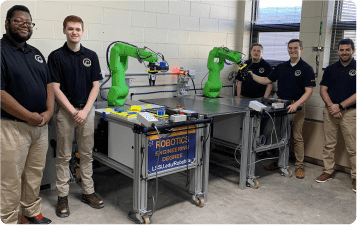
New Staubli robot flow line
Our most recent robot flow-line is comprise of four Staubli robots with a Bosch conveyor system and rotary index tables.

Check out our Robotics Summer Camps for Young Men and Women entering grades 8-12.

Have you been active in FIRST Robotics, Tech or LEGO League? Apply for one of our Robotics Scholarships

We've got robots...

Lake Superior State University is one of the top public universities in the United States with a robotics specialization at the undergraduate level. Companies involved in robotics and automation specifically seek out our graduates.

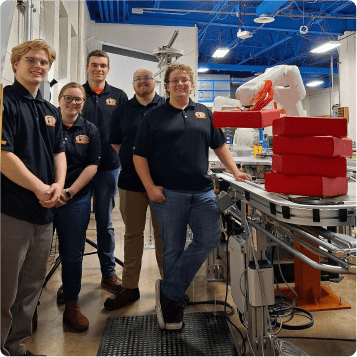
Our Robotics and Automation Laboratory was recognized by TAC of ABET as one of the most complete and advanced of it kind in the country. It is one of the best educational facilities in North America with modern equipment including vision systems, sensors and rotary index tables, using a variety of software and programmable logic controllers (PLCs). Limited enrollment provides you plenty of personal experience with state-of-the-art equipment.

More than 75 percent of our engineering classes have a laboratory component, including robotics, using industrial grade equipment. Our Robotics and Automation Laboratory features robots manufactured by:

Students in Computer, Electrical and Mechanical Engineering can work toward an option in Robotics and Automation. Those majoring in Manufacturing Engineering Technology, Electrical Engineering Technology are eligible to earn a minor in Robotics Technology. The Industrial Technology program feature courses and technical electives focusing on robotics and programming.


STAÜBLI

Our Staubli line is the most recent addition to the lab. Staübli robots are among the fastest and most articlated with 6 degrees of freedom.

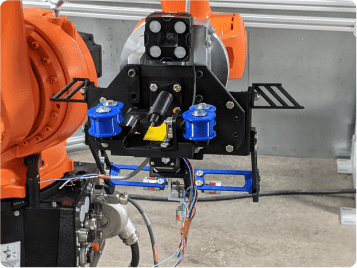
Devon Clark looks at the gripper fingers of the Staubli

Devon Clark, a mechanical engineer from the 2009-10 senior project Team AIR, checks out the gripper of a Stabli line robot.

The work cell features four robots with shared rotary index tables and a Bosch continuous palletizing conveyor system that operate as an 8-station system. The line includes tool changing systems, end-of-arm devices, and vision systems. They are operated by programmable logic controllers (PLCs) using DeviceNet and VAL3 software.


FANUC

Our Fanucs are part of the Arcmate family of robots with six degrees of freedom. They are built by the world's largest robot manufacturer.

Pick and Place Demonstration

Summer camp visitors watch a pick-and-place demonstration by the Fanuc oval line.

The Fanuc work group has four Arcmates surrounded by an oval track. They work together as an 8-station system. Activities are coordinated between the robots with a continuous conveyor system. Karel software is used for programming this workcell.


MOTOMAN

Motoman is one of the three largest robotics companies and one of America's fastest-growing.

Motoman robotThis unit was integrated into a demonstration workcell to showcase it's capabilities. The first of two demonstrations has the robot take two "photos" of a Rubik's cube and then proceed to solve the cube using a program prepared by a senior engineering project team. The second sequence has the robot change grippers with various tooling to be able to assemble an automotive distributor (see recessed area of the work table in photo at left).


ADEPT

This vision-system adapted robot is made by the only U.S. robot manufacturer. It is one of the most widely used selective compliance articulate robot arm (SCARA) type robots.

There are several groupings of Adept robots in the Robotics & Automation laboratory. As noted above, a grouping is a component of the "L line." Recently, three Adept robots were integrated with a rotary conveyor table creating a circular workcell.

Watch the circular Adept workcell assemble a flashlight:

  1. Station 1: pick and place flashlight face and insert bulb assembly
  2. Station 2: place housing on face and screw in; place in batteries
  3. Station 3: place on flashlight backer, test for functionality and place unit into either the "good" or "bad" tray


Determining Phthalate Concentra- tions in Children’s Toys by Gas Chromato- graphy Mass Spectro- metry

Kaitlin Hykel

The majority of plastic toys produced in today’s society come from foreign countries, with China being one of the leading manufacturers. Plastic is composed of various synthetic organic compounds such as phthalates, but they can impose serious health effects especially to young children. As a result, regulations have been put in place to monitor the use of these harmful compounds. This study focuses on the extraction of phthalates from children’s toys to determine whether the concentrations are within the range of regulated phthalate use.

Apply Today!

Home > Robotics & Automation at LSSU
Share this page with your friends: