
 Feb 12, 2026
CONTACT: LSSU Marketing | m[email protected] | 906.635.2692
SAULT STE. MARIE, Mich. – Lake Superior State University is significantly expanding its capacity for Great Lakes research and hands-on opportunities thanks to a $3 million investment from Dick and Theresa Barch. The donation supports the creation of the Richard and Theresa Barch Endowed Executive Directorship at the university’s Center for Freshwater Research and Education (CFRE), marking the first named directorship in LSSU’s history.
The gift will establish an Excellence Fund to support student research, the acquisition of advanced equipment, and provide a new, larger research vessel, giving students expanded opportunities for hands-on learning and real-world experience.
“This investment strengthens our ability to grow research and student training at a scale that impacts not only LSSU, but all those who appreciate the Great Lakes and freshwater ecosystems,” said Dr. Ashley Moerke, Executive Director at CFRE. “It helps ensure that Barch CFRE has the resources to conduct research and gather data that informs conservation, policy, and resource management across the Great Lakes region.”
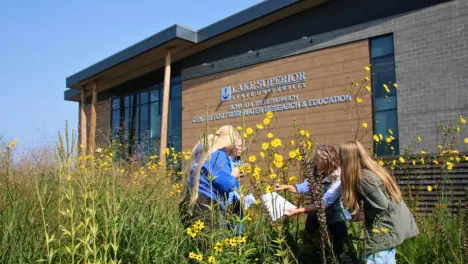
Barch CFRE serves as a hub for applied freshwater research and workforce development in the Great Lakes region, regularly collaborating with tribal, federal, and state agencies, as well as industry partners, to address real-world environmental challenges. Students engage directly in laboratory work, field sampling, and long-term research studies, producing science that impacts Great Lakes-wide decision-making and conservation efforts.
“This level of support enables us to expand the scope of our research and involve more students directly in applied fieldwork. The timing is especially critical as we launch our new accelerated Master’s program in Fisheries & Wildlife Management,” said Dr. Kevin Kapuscinski, Professor and holder of the Vanderploeg Endowed Assistant Directorship at CFRE. “With upgraded equipment and a larger vessel, we can conduct work that helps protect the Great Lakes while training students for careers in conservation and management of natural resources.”
Students gain experience that extends far beyond the classroom, benefiting from LSSU’s unique position as Michigan’s smallest public university. Support from private donors like the Barches is crucial to sustaining these opportunities, protecting ecosystems at the headwaters of the Great Lakes, and giving students direct involvement in research with real impact. For a university of its size, a gift like this is truly historic, highlighting a growing trend of investment in regional freshwater research, while also elevating LSSU’s profile as a leader in Great Lakes science.
“I have had the great opportunity to take classes and work at Barch CFRE for the past two years: analyzing water quality characteristics, sampling fish and algae, and engaging the public in the vast world of freshwater resources. CFRE bridges the divide between theory and real-world impact by providing students with hands-on experiences and applied research initiatives,” said senior Fisheries and Wildlife Management student Aiden Cardwell. “The Barch Center, and all that it facilitates, has been instrumental in shaping my professional and personal life, my sense of place, and my appreciation for freshwater and fishery sciences—an impact this generous gift will ensure is felt by many others to come.”
LSSU recently announced an accelerated 4+1 Master’s Program in Fisheries and Wildlife Management, allowing students to complete both undergraduate and graduate degrees in just five years while gaining hands-on experience and completing a research-based thesis. Cardwell is one of the first students to begin this program.
One example of CFRE leading the way in Great Lakes science is recent groundbreaking oil spill research that uses controlled “mesocosms” to replicate freshwater conditions and assess ecosystem responses to oil exposure. Conducted in partnership with Algoma University, the University of Windsor, and the U.S. Coast Guard, the project is giving students research experience while also informing oil spill response and recovery in freshwater systems.
The Barches have a long history of supporting Lake Superior State University and its mission. Their continued investment reflects a commitment to the work CFRE does and the long-term stewardship of natural resources.
“CFRE gives students an experience most other universities can’t offer. They provide an opportunity for hands-on work in rivers, wetlands, and marshes that a classroom or textbook can’t replicate,” said Richard Barch. “Turning over rocks in a river or along a lake bottom brings a kind of personal satisfaction that deepens learning and reveals the complexity of ecosystems. Getting wet, cold, and muddy in waders isn’t a side note at LSSU, but a defining part of the student experience, and one you won’t find in an urban campus setting.”
The endowed directorship strengthens LSSU’s ability to attract research partnerships, pursue external funding, and expand student opportunities, reinforcing the university’s growing role as a leader in freshwater science and workforce preparation.


