
 Sep 28, 2026
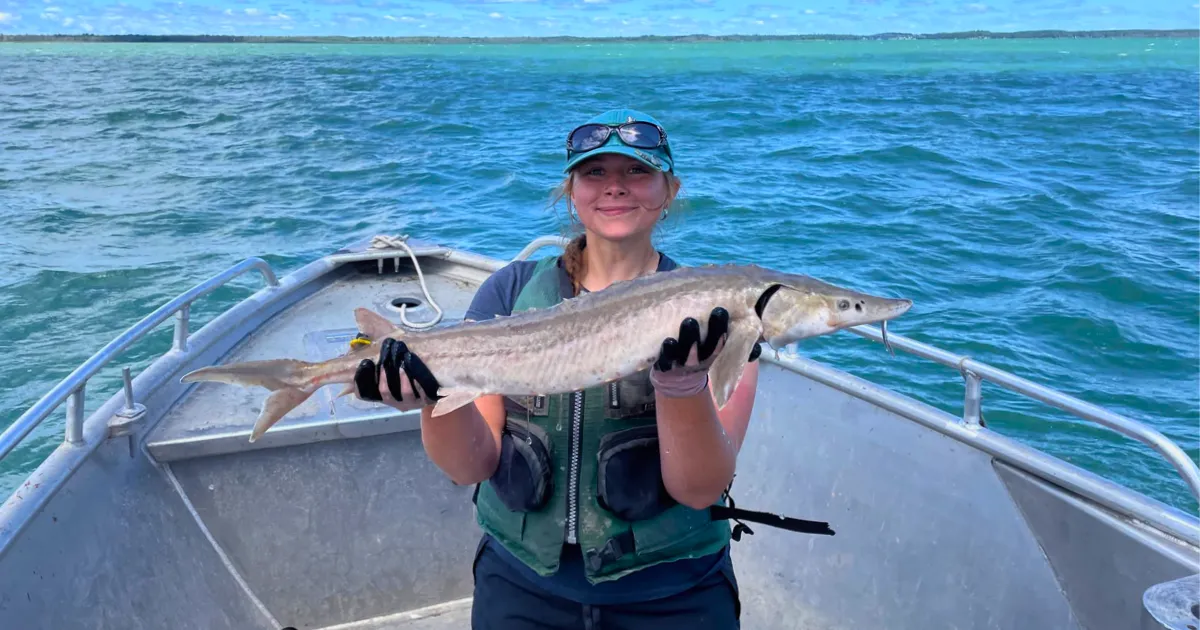
SAULT STE. MARIE, Mich. – Determining the sex of a sturgeon can be surprisingly difficult. A team of LSSU researchers has refined a genetic testing method that makes the process more reliable, offering a useful tool for fisheries research, conservation, and aquaculture.
The research, led by LSSU Professor Britton Ranson Olson, was conducted in collaboration with LSSU Professor and Assistant Director of Research at the Center for Freshwater Research and Education (CFRE), Kevin Kapuscinski, and LSSU Master’s candidate Alana J. Miller-Schofield.
Their findings were published Sept. 3 in BioTechniques.
For researchers studying sturgeon populations, knowing the sex of individual fish can provide important information about population characteristics and reproductive dynamics. However, determining their sex can be challenging, particularly outside of the spawning season or in younger fish.
Previous genetic methods have relied on a marker found specifically in females. When that marker was absent, a fish could be classified as male, but the test did not include a way to confirm that the sample and test itself were working properly.
The LSSU team refined that approach by adding an internal genetic control known as cytochrome b. The control is analyzed alongside the existing sex-specific marker using a technique called quantitative polymerase chain reaction, or qPCR.
In simple terms, the added control helps researchers distinguish between a confirmed negative result and a test that didn’t provide enough information.
“We wanted a negative result to actually mean something,” said Professor Olson. “By adding the control, we can tell the difference between a fish that tested negative and a test that didn’t give a clear answer. That validation is critical for having confidence in your results.”
The potential applications extend far beyond a lab test. Researchers can use the method to better understand sex-specific characteristics of wild sturgeon populations, even from archived samples. Determining sex from a small piece of tissue can also reduce handling time compared with methods such as ultrasonography or biopsy.
“Reliable information about the sex of sturgeon can be a crucial piece in understanding how populations are structured and where they are on the path to rehabilitation,” Dr. Kapuscinski said. “This method gives a practical way to get that information from both new and old samples.”
The research also demonstrates the value of collaboration between LSSU faculty and students. Miller-Schofield– a Master’s candidate in LSSU’s inaugural group of students seeking an advanced degree in Fisheries & Wildlife Management – is a co-author of the published study, contributing to research that has potential applications in fisheries science, aquaculture, and other areas of sturgeon management.
“Working on this project has been immensely rewarding,” said Miller-Schofield. “Being involved beyond the classroom and working in the research lab has allowed me to see the entire process of scientific research and publication. The ecological and cultural significance of this research will hopefully inspire future questions and encourage further research on sturgeon.”
The U.S. Fish and Wildlife Service supported the research through the Great Lakes Fish and Wildlife Restoration Act.
The full article, “A refined qPCR duplexing method for the molecular sex determination of sturgeon (Acipenser genus), providing a validating, endogenous control,” is available through the journal BioTechniques.
About Lake Superior State University
Lake Superior State University is a close-knit university in Michigan’s Upper Peninsula where faculty and staff know their students by name. Founded in 1946, LSSU offers a unique personal education shaped by its size, setting, and spirit of community. The University’s one-rate tuition seeks to make education accessible to all students, while Laker athletics foster competitive spirit and school pride. Learn more at www.lssu.edu.
About LSSU’s Center for Freshwater Research and Education
LSSU’s Richard and Theresa Barch Center for Freshwater Research and Education advances the understanding, protection, and sustainable use of freshwater resources through research, education, and community engagement. Located on the St. Marys River, CFRE brings together students, scientists, agencies, and community partners to conduct applied research, provide exceptional hands-on learning experiences, and advance the understanding and stewardship of freshwater resources in the Great Lakes region.
Media Contact
LSSU Marketing
[email protected] | 906.635.2692
###


