Great Lake State Weekend is October 23-24. Find out more!
Page Category: Direct Loan Exit Counseling
Student Achievement
Student Achievement
Throughout all our Schools and Colleges, Lake Superior State University students consistently achieve high scores on state and national tests conducted within their disciplines. They consistently perform with excellence in Senior and Undergraduate Research or Projects. The following links provide student achievement data in specific degree programs:
This page contains public disclosure information associated with the Higher Education Act (HEA) of 1965. The public and institutions should be aware that posting information on a website is sufficient to meet the HEA requirements that institutions make certain information available to the public or others. For additional details see: https://nces.ed.gov/pubs2010/2010831rev.pdf
IPEDS
The Data Feedback Report from IPEDS graphically summarizes selected institutional data and compares that data with peer institutions. LSSU submits information to the National Center for Educational Statistics, which includes student enrollment data, student retention rates, graduation rates, etc. The IPEDS Data Feedback Reports (DFR) are publicly available at: https://nces.ed.gov/ipeds/Home/UseTheData and reproduced below for convenience.
The Common Data Set (CDS) initiative is a collaborative effort among data providers in the higher education community and publishers, as represented by the College Board, Peterson’s, and U.S. News & World Report. The combined goal of this collaboration is to improve the quality and accuracy of information provided to all those involved in a student’s transition into higher education, as well as to reduce the reporting burden on data providers. This data is maintained by LSSU’s Office of Institutional Research: https://www.lssu.edu/institutional-research/common-data-set/
Assessment
Assessment
Assessment of student learning at Lake Superior State University encompasses the total student learning experience, in the classroom and beyond.
Academic assessment is an ongoing, open, evaluative process focused on improving student learning. To accomplish that goal, the University ensures that learning expectations are made clear to students and establishes appropriate learning outcomes at the course, program and university levels. Assessment is essential to determine how well student performance matches the expected outcomes, and the resulting information is used to inform changes in courses and programs for the improvement of student learning.
Cocurricular assessment is equally focused on using ongoing evaluative processes to support and improve student learning. Cocurricular assessments are conducted annually through programs and events sponsored by Student Affairs, such as the Laker Success program that provides student success coaching within dorms and to commuter students. Academic Services conducts cocurricular assessment for tutoring, supplemental instruction, and library instruction on academic integrity and information literacy. Cocurricular assessment provides data to inform and make changes for the improvement of services and student learning.
Operational support assessment is an ongoing, open, evaluative process focused on improving university culture and services. It requires the University to make its service and cultural expectations clear to its stakeholders, and establishes appropriate outcomes at each level of operation. It helps determine how well performance matches the expected outcomes, and the resulting information is used to inform changes at the unit and university levels for the improvement of the total student learning experience.
Lake Superior State University’s Institutional Learning Outcomes
The Institutional Learning Outcomes (ILOs) at LSSU describe the knowledge, abilities, and attitudes that our graduates are expected to acquire prior to graduation, as a result of their overall experiences with any aspect of the University. The ILOs were written by faculty and adopted by approval from the Board of Trustees on November 3, 2017. These outcomes help guide University departments in constructing ILO-connected student learning outcomes for programs, courses, and student services. Annual assessment of those ILO-connected outcomes occurs within departments. Institution-wide direct assessment of the ILOs is conducted annually in capstone courses, among student workers and student athletes, and through extracurricular activities. These annual assessments evaluate students’ development and achievement of these outcomes at multiple touchpoints throughout their years spent at LSSU:
Formal Communication – Students will develop and clearly express complex ideas in written and oral presentations.
Use of Evidence – Students will identify the need for, gather, and accurately process the appropriate type, quality, and quantity of evidence to answer a complex question or solve a complex problem.
Analysis and Synthesis – Students will organize and synthesize evidence, ideas, or works of imagination to answer an open-ended question, draw a conclusion, achieve a goal, or create a substantial work of art.
Professional Responsibility –Students will demonstrate the ability to apply professional ethics when answering a question, solving a problem, or achieving a goal.
Intercultural Competency – Students will display knowledge of, and interact effectively with, members of groups whose identities, beliefs, behaviors, and values differ from their own.
Resources
Curricular, cocurricular, and operation areas report assessment data and track data-driven action plans in Nuventive Improve™.
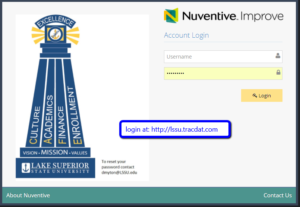
Faculty and Administrator log in to the Nuventive Improve™ system through this link:
“Assessment Matters”
Course level and Program level assessments are reported annually in Nuventive Improve™ and used to facilitate ongoing improvements to academic programs, academic services, and other student services across campus. Additional assessments in cocurricular, extracurricular, and administrative areas are also conducted to promote and facilitate a culture of continuous improvement at Lake Superior State University.
In 2015, surveys gathered input from faculty and staff to gauge campus-wide perceptions of assessment practices and value at LSSU. This information helped focus LSSU’s efforts to improve assessment practices across campus, and to more effectively concentrate those efforts on using assessment to drive continuing improvements in student learning, student services, and across the University. The survey was re-issued with minor modifications in 2020 to evaluate changes in campus-wide perceptions of assessment practices and value at LSSU. Among faculty, the 2020 survey results showed increasing assessment and quality of assessment of student learning overall among faculty, increasing commitment to learning assessment among faculty, increasing effectiveness of assessment methods among faculty, and increasing impact of assessment on courses and programs. Among staff, the 2020 survey results showed increasing commitment to assessment as a means of directing decisions and improvements within departments, and a perception that assessment is increasingly relevant to how individuals perform in the workplace.
From 2012-2016, the University demonstrated its student-learning focus through its voluntary participation in the HLC Academy for Assessment of Student Learning. Through this process, the University strengthened learning-centered course and program assessment activities through a four-year sequence of events and interactions. Those activities successfully targeted and advanced the institution’s efforts to assess and improve student learning, and amplified the institution-wide commitment to productive assessment of student learning that is now firmly ingrained at LSSU.
HLC Academy 2012-2016
2012-2016 Academy for the Assessment of Student Learning.
From 2012-2016, the University demonstrated its student-learning focus through its voluntary participation in the HLC Academy for Assessment of Student Learning. Through this process, the university matured and elevated its commitment to course and program assessment activities through a four-year sequence of events and interactions. LSSU’s efforts in the Academy helped to direct and intensify the University’s culture of robust assessment processes in support of an institution-wide commitment to student learning. The University entered the Academy in the summer of 2012 graduating with a successful project in June 2016.
Memoranda and supporting documents from The Assessment Committee/Academy Team providing feedback and recommendations regarding assessment, program review, and accreditation.
The University Assessment Committee provides assessment oversight, and promotes and supports assessment across all areas of the institution.
Academic assessment is an ongoing, open, evaluative process focused on improving student learning. It requires the University to make its learning expectations clear to students and to establish appropriate learning outcomes at the course and program levels. It helps determine how well student performance matches the expected outcomes. The resulting information is used to inform changes in courses and programs for the improvement of student learning.
At the institutional level, operational units assess the learning achieved by their student workers, and those units also assess learning outcomes specific to their service interactions with students. In addition, all operational units conduct full reviews of their programs, services, and processes on a five-year cycle. The resulting information is used to direct improvements within the units, and to support and improve student learning.
Nuventive Improve™ is LSSU’s centralized assessment database, designated to archive assessment findings and to provide reporting tools for institutional analysis and continuing improvement actions across all areas of the University.
Nuventive Improve™
Committee Membership
The University Assessment Committee is comprised of a representative group from the broader campus, each overseeing and reporting for assessment initiatives in their areas:
Co-Chair: Kimberly Muller (Interim Provost & Vice President for Academic Affairs)
Co-Chair: Gail Essmaker (Vice-Provost for Accreditation & Assessment)
Kathy Berchem (Dean, College of Health & Behavior)
Charlotte Kostelyk (Faculty; General Education Committee member)
Thomas Meacham (Faculty; Director of the Arts Center)
Mindy McCready (Faculty; Chair: Lukenda School of Business)
Mike Beazley (Dean of Student Affairs)
Kate Bergel (Director of Human Resources, Title IX, Safety, & Risk)
Gabriel Schmidt (Assistant Athletics Director)
Admission/Financial Aid representative (currently unfilled)
Business Operations representative (currently unfilled)
Charge to the Committee:
The University Assessment Committee will meet monthly. The broad composition of this committee ensures that every area on campus is engaged in annual assessment, including reporting of results and use of results.
Members of the committee will report assessment data, including findings, use of results, and budget implications, from their own units to the committee. The committee will perform collective data analysis for all reporting units to produce an annual report of that analysis, and its interpretation by the committee, to the Provost’s Office no later than the second Friday in June each year. The committee’s annual report to the Provost will include a summary of all institutional assessments, along with interpretation of those assessments and proposed use of results. Through this evaluative process, the committee will identify any gaps on campus where further engagement in annual assessment is needed. In addition, the annual report of the University Assessment Committee will provide supporting evidence to meet HLC’s Accreditation Criterion 5.C.2: “The institution links its processes for assessment of student learning, evaluation of operations, planning and budgeting.” Lastly, the committee will examine the 5-Year Program Reviews conducted across campus, providing feedback to units.
Instruments of Assessment for Institutional Learning Outcomes (ILOs)
Exit counseling explains the basic facts about the repayment of your Federal Direct Loan(s) along with your rights and responsibilities as a borrower. Other important topics such as deferment, consolidation, and default are discussed. This information will help you to manage the repayment of your student loan debt and to avoid any difficulties that could adversely affect your credit rating or your eligibility for student loans and other aid in the future.
Federal regulations require all students who have received Federal Direct Loans (subsidized and/or unsubsidized) to complete Exit Counseling for the following reasons:
Student has graduated.
Student is attending less than half-time. (Enrolled in less than 6 credits.)
Student withdraws from the University.
Student is not returning to LSSU after his/her current semester ends.
Select School information and then click continue.
Read through the information in order to answer the questions.
Once completed, the indicated school(s) will receive confirmation of completion.
CAUTION: Consolidation of Federal Student Loans with any private loans will convert the Federal Student Loans to private loans. You will lose all Federal deferment, forbearance, and forgiveness options.
If you have any questions, please contact us by phone at (906) 635-2678 or by fax at (906) 635-6669.
LSSU Strategic Plan
Lake Superior State University Strategic Plan 2020-2025
“Superior Education, Superior Experience, Superior You”
In August of 2019, the Board of Trustees and President Rodney Hanley called for the development of a new institutional strategic plan and appointed a committee comprised of seven faculty and staff to draft that plan. The committee held listening sessions to give voice to multiple constituencies in the new Strategic Plan. These constituencies included students, faculty, staff, Tribal Leaders, advisory boards, alumni, and community members. An online survey was created to allow for anonymous input, and received 30 responses. Thirty-five sessions were held with a total attendance of over 300 people. The sessions were facilitated to focus on the future of the university and the directions needed to achieve a prosperous future. This document truly represents broad input from wide-ranging constituencies. The committee’s draft document was turned over to the President and Senior Management Team for their review, input and approval.
The Strategic Plan was approved by the Board of Trustees on April 24, 2020.
We equip our graduates with the knowledge, practical skills, and inner strength to craft a life of meaningful employment, personal fulfillment, and generosity of self within an inclusive atmosphere, all while enhancing the quality of life of the Great Lakes region and the world.
Vision:
We believe in an innovation-driven, transformative education for all. We identify potential, enable success, drive social mobility, and develop students into professionally prepared graduates who excel locally, nationally and globally.
Core Values:
Excellence in Teaching and Learning: Student learning is our first priority and focuses on providing student/faculty interaction, learning, and research in current, relevant programs.
Opportunity: Students have a wide range of opportunities to grow academically, professionally, culturally and socially. Opportunities are provided via work-study assignments, student organizations, internships, community outreach and leadership.
Diversity: Students experience a campus community environment that is inclusive and welcoming.
Ethics and Values: The University promotes an environment that values freedom of expression, the pursuit of truth, honesty, openness, and courteous behavior where everyone is treated with respect.
Stewardship: LSSU provides a framework in which to leave the university and region financially and environmentally sound for future generations of LSSU students, alumni, and friends.
The Aspirational Values of the Strategic Plan are:
Global Interdependence – As part of a global society we promote and celebrate exchange among world cultures through international student recruitment, on-campus support for international students, and promotion of opportunities abroad for students, faculty, and staff. Thus, we bring LSSU to the world and the world to LSSU.
Social Mobility – At LSSU, we are committed to equal access to higher education opportunities that lead to social mobility. LSSU’s supportive, personalized, and welcoming atmosphere particularly benefits first-generation students and those from diverse socioeconomic backgrounds. As one of the few four-year universities in Michigan that grants associate degrees, we are uniquely poised to serve students through the Tuition Incentive Program (or TIP) funding, while facilitating a smooth transition from an associate degree to a bachelor’s degree with guaranteed application of all credits. We are committed to providing resources to students that lead to their success.
Innovation – LSSU embraces innovation as an aspirational value. Given demographic, political, technological, and policy shifts affecting higher education, the University cannot – and will not – stand still. Innovation in the context of this strategic plan means we will unveil new academic programs and enact new processes and methods of teaching; develop new enrollment-driven initiatives; enrich the student experience with both tradition and bold new efforts that enhance the overall student experience; and enhance support networks and interventions for student success. Our innovative process will rely on a strong culture of assessment and data-informed decisions to drive student success and University growth.
Canadian Student Loans
Canadian Student Loan
Canadian students who need help paying for a college or university education may apply for aid through the Ontario Student Assistance Program (OSAP). OSAP offers a mixture of grants and loans.
To be considered for OSAP, you must meet the following requirements (additional qualifications may by required):
Be a Canadian citizen, Permanent Resident or Protected Person;
Meet Ontario residency requirements;
Be enrolled in an approved post secondary institution taking an approved program;
Be taking at least 60% of a full course load, or 40% if you have a permanent disability.
Students who complete an OSAP application may be eligible for the Canada-Ontario Integrated Student Loan (COISL). The loan is funded by both the Government of Ontario and the Government of Canada. The loan is issued through the National Student Loans Service Centre (NSLSC).
Another loan option for Canadian students is available through Global Education Management Services (GEMS). Visit www.myglobaled.com for loan features, program requirements and how to apply.
Federal Direct Student Loan Master Promissory Note (MPN)
Direct Loan Master Promissory Note (MPN)
If this is your first Federal Direct Student Loan, you must complete and sign an electronic “Master Promissory Note” (MPN) at https://studentaid.gov/ before your loan can disburse. Your FSA ID is required to sign in. If you do not have a FSA ID yet, you can create one here. An FSA ID gives you access to Federal Student Aid’s online systems and can serve as your legal signature.